
The Call That Starts With "It Was Fine This Morning"
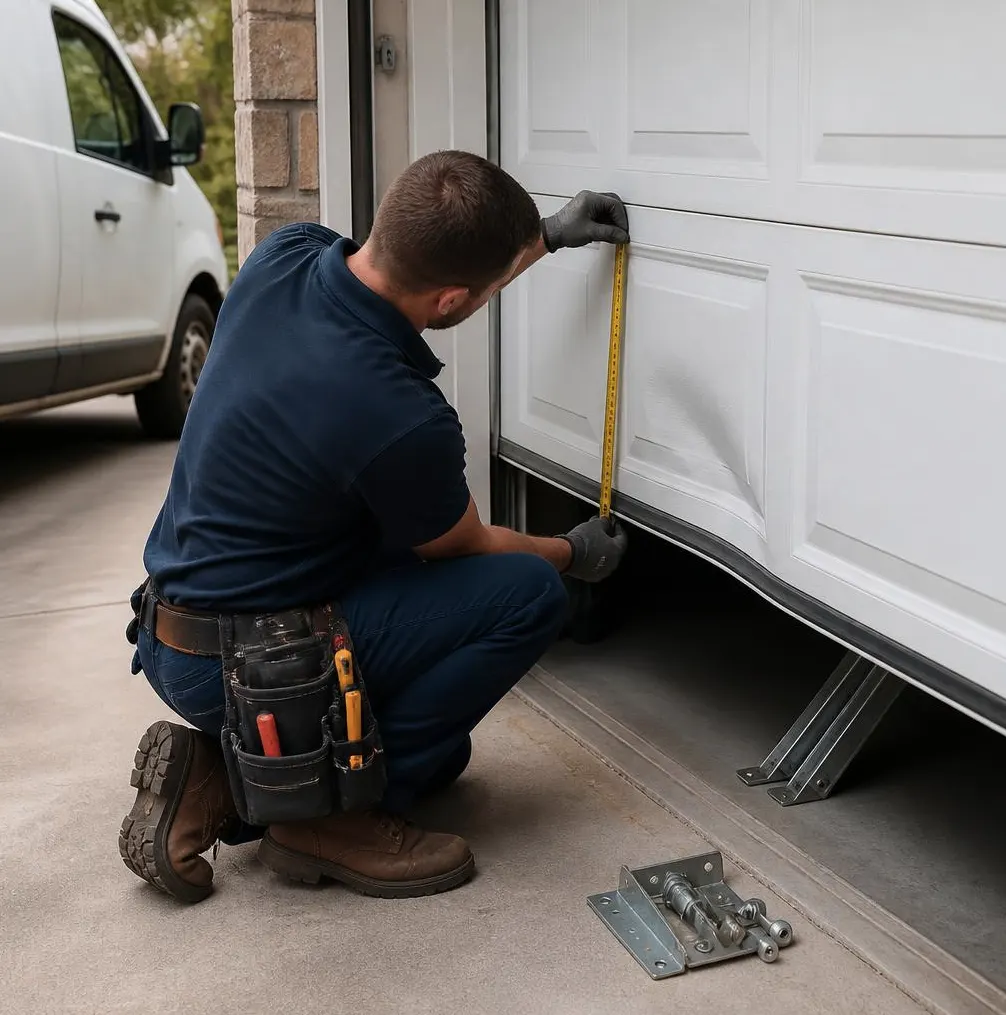
A technician pulls up and the homeowner is standing in the driveway pointing at a garage door that's bowed inward like a sail. The story is always similar: a storm blew through overnight, the wind kicked up hard and fast, and by morning the door panels are bent, a track is pulled loose from the wall, and the door won't budge. Nothing about the door looked weak the week before. That's the part that catches people off guard — wind damage to a garage door rarely gives much warning.
Late in the season here, storms don't always announce themselves with a slow buildup. A clear, hot afternoon can turn into blowing dust and sudden gusts within an hour, and those gusts hit a garage door harder than they hit almost any other part of the house.
Why the Garage Door Is Your Home's Weakest Wall
Every other exterior wall on a house is a solid, continuous structure tied into the frame. The garage door is different: it's the single largest opening in the home, built from several thin panels connected by hinges and rollers, held in place mostly by its tracks and the pressure of the springs. When wind pushes against that surface, the force spreads across the weakest connection points — the hinges, the track brackets, the seams between panels.
If the door fails, it's not just a broken door. Once wind gets inside the garage through a caved-in or blown-open door, it pressurizes the whole structure from the inside, which is how roofs get lifted and walls get pushed outward during severe wind events. The garage door isn't just protecting your car and tools; it's often the first line of defense for the structural integrity of the whole house.
What This Climate Does to That Weak Point
A few local conditions make this worse than it might be elsewhere:
- Dry heat and sun exposure make steel panels and plastic components more brittle over time, so they have less give when wind actually hits them.
- UV fading and weatherstripping breakdown leave small gaps around the door's edges, and wind finds those gaps first, working them wider with every storm.
- Monsoon dust ahead of the rain often arrives as a fast-moving wall of wind before anyone sees a drop of rain, which doesn't give homeowners much time to react if the door isn't already in good shape.
- Cool desert nights after hot days cause metal components to expand and contract daily, which gradually loosens bolts, hinges, and track brackets without anyone noticing.
A Real Pre-Storm Checklist
Most of this takes less than thirty minutes and doesn't require taking the door apart.
- Check the track brackets. Walk the full height of both tracks and look for brackets pulling away from the wall or ceiling. A wrench and a few minutes can retighten most of these.
- Inspect the hinges and rollers. Look for cracked hinges, rollers with flat spots, or stripped screw holes. These are the first parts to give way under wind pressure.
- Look at the weatherstripping. If the rubber along the bottom and sides is cracked, UV-faded, or pulling loose, wind and dust are already getting past it. Replacement strips are inexpensive and worth doing before storm season peaks rather than after a door fails.
- Check for horizontal reinforcement struts. Many doors, especially wider double doors, come with (or can be fitted with) horizontal struts bolted across the back of the panels. These are one of the most effective upgrades for wind resistance and are worth adding if your door doesn't already have them.
- Test the opener's response during a power blip. Storms here often knock out power briefly. Know whether your opener has battery backup, and if not, know how to manually release and lock the door by hand.
- Clear the tracks of dust buildup. Monsoon dust settles into tracks and rollers and can cause the door to bind or move unevenly under stress, exactly when you need it to move smoothly.
Signs the Door Won't Hold Up
A few things point to a door that needs attention before, not after, the next storm: visible daylight around the edges when closed, a door that shudders or rattles even in light wind, panels that look slightly warped or bowed, or a door that's noticeably heavier or harder to lift than it used to be. Any one of these is a sign the door's structural margin is already thinner than it should be.
When to Call Waddell Garage & Gate
If you've found loose brackets, cracked hinges, worn weatherstripping, or a door that just doesn't feel solid anymore, that's the time to get it looked at — not after a storm has already bent a panel or pulled a track loose. Our technicians can do a full inspection and handle garage door repair on worn hardware, or recommend and install horizontal reinforcement struts as part of a broader maintenance and tune-up to get the door storm-ready. If the damage is already done, we also handle repairs and replacements for doors that didn't survive a wind event.
If you're in Waddell, Surprise, Litchfield Park, Goodyear, Buckeye, Peoria, Glendale, or El Mirage and want your garage door checked out before the next storm rolls in off the White Tank Mountains, give Waddell Garage & Gate a call. We'll get it assessed and squared away before the wind does it for you.